
A unit-level simulation of your supply chain. Every decision runs through it.
Built by planners, for planners
Atomic holds a model of your business down to the SKU, site, supplier and week, encodes the rules you plan by, reruns the whole plan continuously, and turns the result into the orders, schedules and allocations your ERP executes. Every number traces to the rule and the input that produced it.
How it fits your business
Built to how you plan, not to a template.
Atomic is built from configurable modules across demand, purchasing, production and MRP, allocation and transfers, and S&OP. AI configures them to encode your planning rules and business logic, at the level you plan, in the words your team uses.
Legacy suites make you bend the operation to the module, and a new channel, co-manufacturer or supplier rule becomes a change order. In Atomic it is a change to the model. DashMart's team built new primary and backup supplier logic with Atomic's AI in roughly an hour and applied it to daily purchases.
The result: a living system planners see, trust, and adjust as the business evolves.
Burned by year-long implementations before?
Start with one decision and add the rest as you go.
What to buy, from whom, and when.
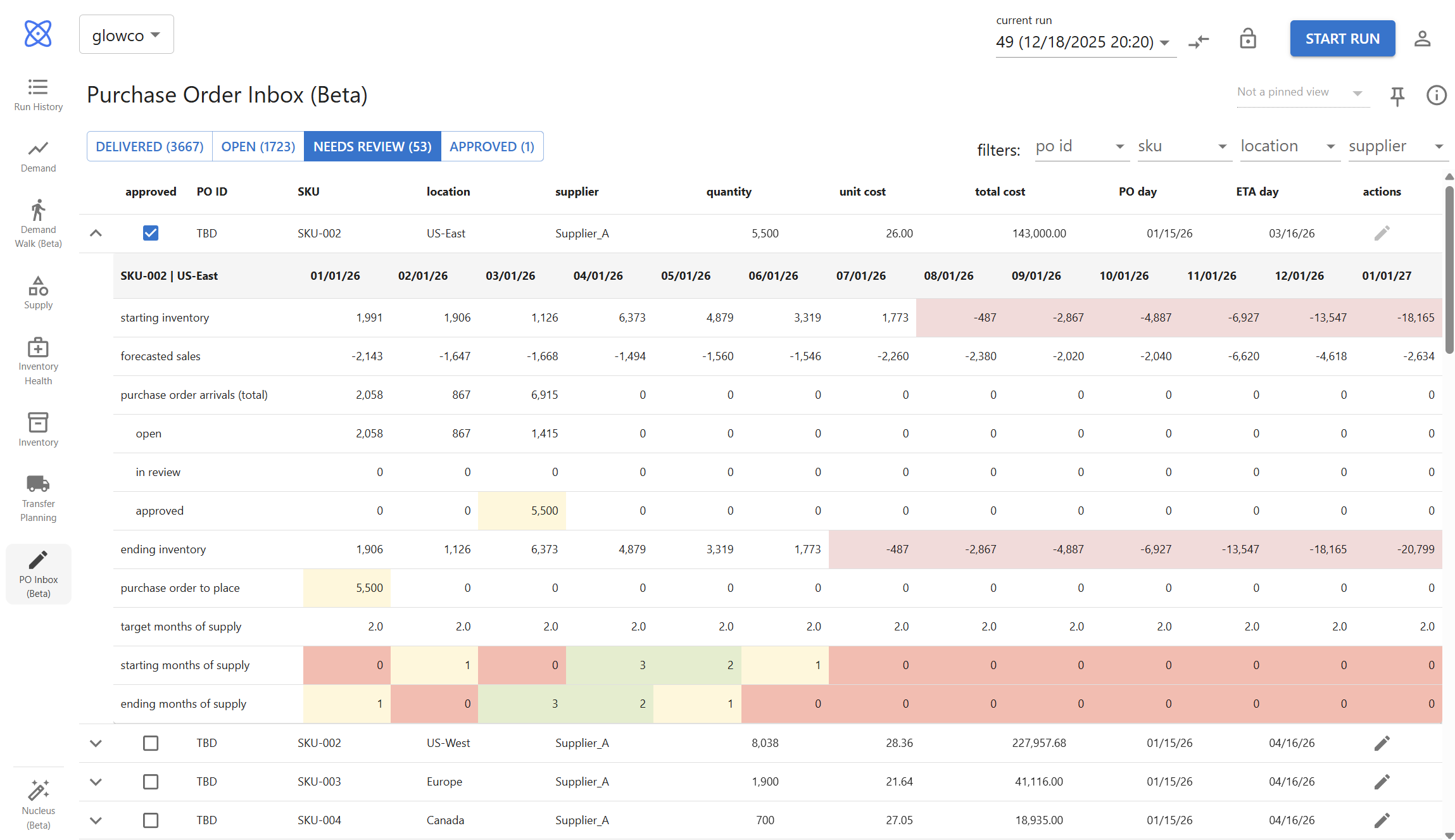
Purchase orders against supplier lead times, contract minimums, pack sizes and cost. MOQs grouped across SKUs that share components. Primary and backup supplier rules. Safety stock and reorder points tuned to your constraints, not a global default. Routine POs go out on approval rules you set; the exceptions land in the PO Inbox with the reasoning attached. At DashMart this is 90% of purchasing across hundreds of sites, with the team on the other 10%.
The AI interface to the plan.
A deterministic engine produces every number. Nucleus explains it, and never invents one. Ask what changed and why, triage the alerts, run a scenario in plain language, draft the S&OP prep, or build a new rule and apply it across the daily decisions. Every interaction is logged and auditable.

Three layers.
Take all three, or start with the top one.
Execution stays in your ERP. POs, work orders, transfer orders and replenishment go back to it on approval.
Data
- Atomic connects to your ERP (NetSuite, SAP ECC and S/4HANA, Dynamics 365, Oracle and others), your WMS or 3PLs, sales channels and sell-through feeds, data lakes, and your existing planning system's outputs.
- Most customers integrate seven or more sources.
- Master data cleanup is part of onboarding, not a prerequisite.
Engines
- The optimization and simulation that turns the model and your rules into a plan: purchasing, production and MRP, allocation and transfers, inventory policy.
- Runs in minutes. Reruns continuously, and on demand.
Intelligence
- Plan of record, versions and approvals, scenarios, reporting, financial tie-out and Nucleus.
- This layer runs on top of Kinaxis, o9, SAP IBP, Blue Yonder, Relex or Anaplan on the data you already have, live in about 30 days.
- Your system keeps producing its plan; Atomic reads it, explains it, tests the alternatives and governs the decisions.
Keep your planning system and add Atomic on top, or move a job into Atomic the way DashMart did: about three months, feature parity, zero business disruption. You decide what stays.
From first call to daily use.
One customer went from first call to live system in about two months — after being quoted six months for an internal build.
Discovery call, 30 minutes
You walk us through how you plan today and what you'd like to improve. We work through your rules and constraints together and identify what Atomic would model first.
We identify what Atomic would model first
The rules, constraints and decisions that matter most.
Your planning in Atomic
We build an initial version around the rules, constraints and decisions we discussed, then demo it back to you.
Decide together
If it fits, we agree the first decision Atomic will run and what stays where it is.
Onboarding alongside your current plan
Data first, then a baseline that replicates what you do today, then improvements you approve. Your team keeps its current process until it trusts the new one. About 30 days for the S&OP layer on the data you already have; about three months for a full replenishment network; four to six months for a full deployment across purchasing, production and allocation.
Ongoing
A shared Slack channel, planners on our side who have done the job, quarterly business reviews. Change the model as the business changes, in days or weeks, not through a change order.
Tell us what's unique about how you plan.
30 minutes. Walk us through how you plan today and what you'd like to improve. We'll work through your rules and constraints together and show you how Atomic could be tailored to your business.